There are two book reviews I’d like to post, by way of comparing great writing with crap writing. My original thought was to interleave snippets from these two books, allowing one to make its own case and the other to dig its own grave, more or less unassisted. But when it comes down to it I’d rather not besmirch Michael Chabon’s lovely new Telegraph Avenue by using it to bludgeon and flagellate the watery, pious and flimsy British novella we will now subject to its due mortification— a novella that inexplicably won the 2011 Booker Prize. This is the same prize for which Cloud Atlas, a novel of surpassing genius whose forthcoming movie adaptation I’m anticipating with equal shares of dread and ecstasy, was only shortlisted. At this point I’m assuming that the prize is either as corrupt as Wine Spectator, or as lazy and chauvinistic as the Guide Michelin. I’ll reconsider when David Mitchell wins it.
Perhaps a disclaimer is due. The opinions below are purely my own, it would seem. No, really. Critics at The New Yorker, The Guardian, The SF Chronicle, The Washington Post, The LA Times, Vogue, The Wall Street Journal, The Boston Globe, The New Republic and many other fine purveyors of culture, not to mention my Facebook friends (hello Sara and Carlos), all seem to love the book I’m about to castigate. Maybe when I’m of a certain age the “great but invisible skill” with which Julian Barnes has rendered his “crystalline truths that have taken a lifetime to harden” will suddenly become less invisible? Or maybe the emperor has no clothes.
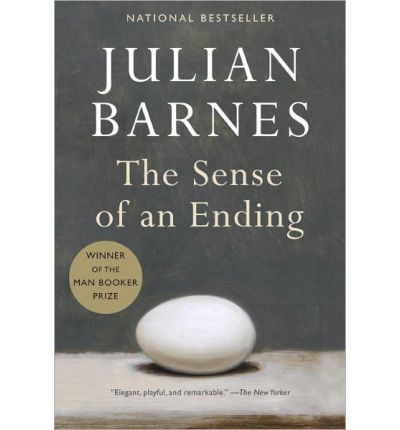
 Let’s begin with the title: The Sense of an Ending (apparently “lifted from a work of literary theory by the critic Frank Kermode”). Does it get any more half-assed than that? Actually, yes:
I saw it in his face. It’s not often that’s true, is it? At least, not for me. We listen to what people say, we read what they write— that’s our evidence, that’s our corroboration. But if the face contradicts the speaker’s words, we interrogate the face. A shifty look in the eye, a rising blush, the uncontrollable twitch of a face muscle— and then we know. We recognise the hypocrisy or the false claim, and the truth stands evident before us. (p. 150.)
Now we know! If only this wisdom had been written in the right decade, Carl Sagan could have had it read aloud by Peter Ustinov and engraved on the gold record we sent into space, the better to prepare the aliens for discourse with humans.
 In case you’re wondering, I picked this passage because it’s about as writerly as it gets over the course of TSoaE’s 163 pages. What, is this not “elegant, playful and remarkable”* enough for you?
(*Quoth The New Yorker and the book’s front cover, under an inexplicable painting of an egg perhaps elegantly and playfully, if unremarkably, in peaceable repose on a table.)
 OK, let’s move on to the dialog course, the better to observe Julian Barnes’s keen psychological insight in action:
So I sent an email to Veronica. I headed it “Question,” and asked her this: “Do you think I was in love with you back then?” I signed it with my initial and hit Send before I could change my mind.
The last thing I expected was a reply the next morning. This time she hadn’t deleted my subject heading. Her reply read: “If you need to ask the question, then the answer is no. V.”
[yr. humble crit.: at this point it’s hard not to imagine bringing in Beavis and Butthead as guest critics. “Try sexting her dude! Heh heh heh.” “Uh.. huh huh huh.. yeah, sext her.. like, let her know how you really feel.”]
It perhaps says something of my state of mind that I found this response normal, indeed encouraging.
It perhaps says something else that my reaction was to ring up Margaret and tell her of the exchange. There was a silence, then my ex-wife said quietly, “Tony, you’re on your own now.” (p. 116.)
So what did it say about his state of mind the first time, and what something else did it say the second time? I like how there are four layers here of reality, right— Tony in the moment, Tony at a narrative remove, the infinitely inscrutable & pissy Veronica, and the infinitely wise & suffering Margaret. Chicks always know best.
Reading this treacly tale of late middle age cluelessness, one does get “the sense” that the English public schools of the 50s and 60s didn’t do much for the development of emotional intelligence in male youth— at least not for straight boys like Tony and, presumably, Julian. This reminds me how grateful I am that, although love and intimacy lost are such central themes in TSoaE, there are— praise small mercies— no actual sex scenes in this book. Our good fortune is underscored by the following close call:
I wasn’t exactly a virgin, just in case you were wondering. Between school and university I had a couple of instructive episodes, whose excitements were greater than the mark they left. So what happened subsequently made me feel all the odder: the more you liked a girl, and the better matched you were, the less your chance of sex, it seemed. Unless, of course— and this is a thought I didn’t articulate until later— something in me was attracted to women who said no. But can such a perverse instinct exist? (p. 25)
I know, I know. The book is like ambrosia, but strained through the cheesecloth of an unreliable narrator. It’s postmodern! The problem is that for us to care about and become invested in an unreliable narrator, such that we can be all shocked and upset later on when the bubble bursts, we need to be drawn in enough to inhabit his perspective early in the book. This is hard to do in Tony’s case, because he’s so obviously an ass. One feels frankly insulted that Mr. Barnes would find it plausible for the reader to find this schmuck and his philosophical musings a good impedance match.
Even leaving this issue aside, the unreliable narrator trick requires not only technical skill, but also exceptional sensitivity on the part of the (real) author, in order to bring the “reveal” into focus at the right speed, at the right time, and with the right force. It’s a demanding feat of ventriloquism, beyond even the usual rigors of free indirect style, and to pull it off the author needs to be working at a far subtler level than the unreliable narrator. Of course when one writes one also becomes emotionally close to and invested in the characters— even more so than the reader; it’s necessary to do so in order to make the voices true. However, it’s equally necessary to become close to the characters who are not doing the narrating, to invest the text with their voices— maybe obliquely at first, then more clearly in the endgame. Otherwise the “reality” undergirding the story will be just as lame as the unreliable narrator’s reality. And we won’t care.
And this is just what happens. My recurring feeling, when reading TSoaE, was that Julian Barnes and Tony Webster were too nearly the same person. It got pretty claustrophobic up there in Tony/Julian’s head. When the Wise Women made their appearances, they came off flat and gnomic, deployed more in the manner of unyielding bollards along the sidewalks of the plotline than as real voices that could perhaps have turned this story into something more three-dimensional. In the absence of other voices, the shifts in perspective afforded by the series of big insights and realizations experienced by Tony himself really failed to provide the necessary stereo separation.
Let’s end with a “Royale with Cheese” moment toward the end of TSoaE— on page 158. By this late stage, the story is as senescent as Tony himself; all investments in character growth etc. are made; the chips, as it were, are on the table:
One day, I said to the barman, “Do you think you could do me thin chips for a change?”
“How do you mean?”
“You know, like in France— the thin ones.”
“No, we don’t do them.”
“But it says on the menu your chips are hand-cut.”
“Yes.”
“Well, can’t you cut them thinner?”
The barman’s normal affableness took a pause. He looked at me as if he wasn’t sure whether I was a pedant or an idiot, or quite possibly both.
[yr. h.c.’s: “both! Heh heh heh.” “Huh huh.. yeah dude.. both.”]
“Hand-cut chips means fat chips.”
“But if you hand cut chips, couldn’t you cut them thinner?”
“We don’t cut them. That’s how they arrive.”
“You don’t cut them on the premises?”
“That’s what I said.”
“So what you call ‘hand-cut chips’ are actually cut elsewhere, and quite probably by a machine?”
“Are you from the council or something?”
“Not in the least. I’m just puzzled. I never realized that ‘hand-cut’ meant ‘fat’ rather than ‘necessarily cut by hand.’”
“Well, you do now.”
“I’m sorry. I just didn’t get it.”
I retired to my table and waited for my supper.
And there’s the moral of the story: Tony Doesn’t Get It. Pretty “adroit handling”, right, to use hand-cut chips as a metaphor for, you know, other stuff? Like how you can’t turn an English lover into a French one?
What really made me smile over this little passage was how clearly it was drawn from life. I’m willing to bet that it was actually Julian Barnes who one day had this exchange with the barman at his local pub. Barnes and Webster: just too cozy with each other. Chips cut from the same potato.
OK, now I feel soiled and guilty, like Alex after beating up the old guy in A Clockwork Orange. It’ time to move on. I’m going to try not to let my new contempt for the Booker presumptively color my opinion of Hilary Mantel, whose Bring up the Bodies was already on my to-read shelf before the recent announcement that she’s won the prize for 2012.
2 Responses to the sense that the booker prize sucks